Legislative Resolutions, Legislative Priorities for 2013: #2 Block Grant Funds to States

Given President Obama’s abdication in presenting select priorities to the Congress, Selfish Citizenship took the initiative to spell out the top seven legislative priorities for 2013 at the beginning of the year.

The Congress has infringed upon the states’ police powers by giving the states federal money with strings attached.  This is the method by which Congress has exceeded the limits of its constitutional authority.  To restore the federalist principle, the Congress should change all funding of state and local programs into block grants to the states without any strings attached.

As an example of the arbitrary power the executive wields as a result of the current process, see the efforts of states to get waivers from the Obama Administration related to the failed No Child Left Behind law.

This change will reduce federal spending by eliminating oversight and compliance expenses; however, federal civil rights enforcement should continue.  Over time, five to ten years, the value of block grants to states should be regularly diminished to zero as the states transition from these federal mandated programs.  These programs include Medicaid, unemployment insurance, and education funding.

Following the initial posting of these top legislative priorities, the budget developed under the leadership of Rep. Paul Ryan and passed by the House included aspects of this block grant recommendation.  Before we drop context, it should be remember that this was an initiative during the Gingrich Revolution of 1994, yet we still have the same problems on only a larger scale.  Current House Republicans lack the integrity to fully complete this task.

In summary of the seven legislative priorities, Congress needs to take the lead in fixing the problems created by prior Congresses.  All of these man-made problems were the predictable consequence of choices made in the Congress.  Now is the time for Congress to choose differently and these seven New Year’s Resolutions for Congress are a solid start.

Links to all the priorities that Congress should set:

#1 Reduce Regulations
#2 Block Grant Funds to States
#3 Eliminate Small Programs
#4 Sell Federal Assets
#5 Tax Reform
#6 Oversight
#7 Defund ObamaCare

Posted in Congress | Tagged , , , , | 5 Comments

A Turn for DeWurst, an alternative to the state of education in America

One of the personally most important books that I have read is Sydney Kendall’s novel A Turn for DeWurst.  I read it with my youngest daughter; its theme, plot, and character helped establish a solid foundation for real fact based dialogue between my daughter and I on the value and methods of education.

The drama of the novel brings uncomfortable facts about public education to the forefront in a way that they can neither be evaded nor accepted as in the best interest of the child.  Unfortunately, these facts are well known to parents from their own experience in public schools and the experience of current students, but for the most part parents and children are not openly and honestly talking to each other about them.

In addition, as a work of romantic fiction, the novel through its characters and their choices demonstrate a correction, not a reform, to the cause underlying the problems in today’s public schools.  Yet, throughout, the book is full of benevolent passion and love for education and the developing lives of children.

In general, the novel is a wonderful story of many rich characters confronted with challenges and making choices.  The young reader will see dramatized how some of the choices foster life and others corrupt it.  The novel includes both children and adults who act as heroes in normal real life circumstances of school, but also both children and adults who choose to act as villains.

While I have purchased more copies of this book than any other and given them as gifts, the best testimonial for this book comes from my youngest daughter now grown.  Many years after we had read the book together, my daughter told me that she wanted to name a future daughter Astrid specifically after the main character of A Turn for DeWurst ; what a wonderful legacy of a heroine to give to the next generation.

Extra Point

Fifteen books that I have read that will always stick with me

Follow on Twitter Like on Facebook RSS Feed Email Subscription

Join the Selfish Party BannerBeSelfish_sharebanner

Posted in Education | Tagged , , , , | 6 Comments

Thanks for the cheap train ride…Suckers!

The other day a coworker asked me jokingly, “Soon you are going to have that shiny new public train running almost from your doorstep and straight to the office.  Don’t you feel bad that drivers on the parallel public toll way are paying higher tolls to finance that train for you?”

To which, I replied to his surprise, “No.  They choose to have a public train instead of a private one, so it is correct that they suffer the consequences of their bad judgment.  It is their own premises that are coming back to bite them.”

It is an interesting contrast.  I did not support the public train, because I thought it should be privately constructed and owned; just as there was a private train that ran a parallel and longer route before the public turned that graded train track into a bike path, d’oh!  In addition, to the public capital outlay for construction, I can expect that every time that I ride the train that I will pay a discounted fare subsidized by the voters, who support politicians who attack private ownership and demand publicly owned transportation.

To say that it is publicly financed is a bit of a misnomer, as local property owners will be paying higher taxes, which is an interesting shell game.  Previously, the county building codes restricting construction of taller building, which depressed land values; now, the county has eliminated that restriction to finance the train.  Hence, the private property owners were capable of financing better local transportation independent of government, but local government regulation of property forbade it.

Meanwhile, the federal government is also subsidizing the construction of this train, which helps to offset the higher costs the feds impose upon human development with environmental and labor laws.  Think about that for a minute; all the feel good legislation, which is inconsistent with reality, increases costs to an extent that the federal government chooses to spend money to overcome the obstacles to human development created by the government.  Instead of waiving those costs at no additional cost to taxpayers, the obstacles are maintained and human development is held hostage to political approval and subsidy.

This situation reminds me of a fictional train from the novel Atlas Shrugged.  As the train approaches its doom, a head on collision with a munitions train in a tunnel running through a mountain, Ayn Rand, the author, explorers how the premises, values, and choices of the individual passengers led to their eminent deaths; those soon-to-be-dead passengers were not victims, but co-conspirators in the disaster.  Similarly, with this new public train in reality, the public expenses and subsidies are the consequence of the voters support for politicians, both Democratic and Republican, who attack private property and impose a crippling regulatory burden on business.  If those voters suffer the consequences of their choices, then I have no sympathy for them.

Perhaps, you expected gratitude for the shiny new train; no, from me, you will receive only contempt and an “I told you so” related to its financial drain on the public.

Follow on Twitter Like on Facebook RSS Feed Email Subscription

Join the Selfish Party BannerBeSelfish_sharebanner

Posted in Questions | Tagged , , , , , | 2 Comments

Legislative Resolutions, Legislative Priorities for 2013: #1 Reduce Regulations

Given President Obama’s abdication in presenting select priorities to the Congress, Selfish Citizenship took the initiative to spell out the top seven legislative priorities for 2013 at the beginning of the year.

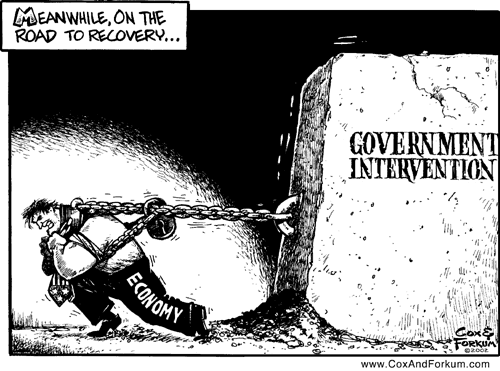
While spending and taxing are given high priority in partisan rhetoric, federal regulation of business has led to Obama’s retarded economy; although in fairness, this is a problem created by Congress over decades.

The stacks of federal regulations infringing upon our freedom to contract, trade, and associate plus the locust of lawyers associated with them need to be removed from the backs of American businessmen.  Job flight overseas is more a consequence of regulatory compliance costs than high wages.

Cutting regulations will reduce spending on enforcement, reduce private waste on compliance, increase revenue by freeing trade within our country, and increase employment opportunities for Americans.

In summary of the seven legislative priorities, Congress needs to take the lead in fixing the problems created by prior Congresses.  All of these man-made problems were the predictable consequence of choices made in the Congress.  Now is the time for Congress to choose differently and these seven New Year’s Resolutions for Congress are a solid start.

Links to all the priorities that Congress should set:

#1 Reduce Regulations
#2 Block Grant Funds to States
#3 Eliminate Small Programs
#4 Sell Federal Assets
#5 Tax Reform
#6 Oversight
#7 Defund ObamaCare

Extra point:  From Cox & Forkum,

RoadToRecovery-X

Posted in Congress | Tagged , , | 5 Comments

Is the Great Recession really over?

I did not realize that we are many years into President Obama’s economic boom times.  Reportedly, the Great Recession ended only a couple months after our President took office, but that must be former President Bush’s fault.  Yet, to me, it does not seem like we are years into an economic expansion, so I smell a rat.

Beyond what I see with my eyes and the knowledge that I have that I am underutilized and less productive than I was, two points are coming to mind: (1) President Obama saying that we cannot cut federal spending or GDP would fall, and that we needed to support state and local government spending, and (2) John Allison’s point in The Financial Crisis and the Free Market Cure: Why Pure Capitalism is the World Economy’s Only Hope that federally mandated accounting obscures reality.  In addition, the Financial Times reports that the methodology used to calculate GDP will be changed by the government resulting in a 3% increase in GDP just from the change of method.  As Brent Moulton of the Bureau of Economic Analysis explains it, “We are carrying these major changes all the way back in time – which for us means to 1929 – so we are essentially rewriting economic history.”

According to the Commerce Department’s Bureau of Economic Analysis’ FAQ, they provide the following guidance on defining a recession (emphasis added):

In general usage, the word recession connotes a marked slippage in economic activity. While gross domestic product (GDP) is the broadest measure of economic activity, the often-cited identification of a recession with two consecutive quarters of negative GDP growth is not an official designation. The designation of a recession is the province of a committee of experts at the National Bureau of Economic Research (NBER), a private non-profit research organization that focuses on understanding the U.S. economy.

The National Bureau of Economic Research provides the following description of their purpose and method (emphasis added):

A recession is a significant decline in economic activity spread across the economy, lasting more than a few months, normally visible in real GDP, real income, employment, industrial production, and wholesale-retail sales. A recession begins just after the economy reaches a peak of activity and ends as the economy reaches its trough. Between trough and peak, the economy is in an expansion. Expansion is the normal state of the economy; most recessions are brief and they have been rare in recent decades…In determining whether a recession has occurred and in identifying the approximate dates of the peak and the trough, we therefore place considerable weight on the estimates of real GDP issued by the Bureau of Economic Analysis (BEA) of the U.S. Department of Commerce…The committee places particular emphasis on two monthly measures of activity across the entire economy: (1) personal income less transfer payments, in real terms and (2) employment. In addition, we refer to two indicators with coverage primarily of manufacturing and goods: (3) industrial production and (4) the volume of sales of the manufacturing and wholesale-retail sectors adjusted for price changes…The committee’s approach to determining the dates of turning points is retrospective.

According to the NBER, the Great Recession ended June 2009 and we are in a period of economic expansion. Do you feel the economic expansion?  Me neither; I expect the same is true for all the unemployed and underemployed young people that I know.

Even if GDP is not the sole determiner of economic recessions, it is the key measure for that determination.  So how is GDP calculated?  As reported by Wikipedia:

GDP = private consumption + gross investment + government spending + (exports − imports)

REALLY???? Government spending?  No wonder our President warns that cutting government spending at the federal, state, and local level will reduce GDP; given a static analysis, it is right there in the equation.

Now, I am not an economist, and don’t pretend to have great insights into the field of economics.  However, I am pretty well familiar with something that I would like to introduce to our erudite economists:  “Economists, this is reality.  Reality, these are economists; please show them your consequences.”

Our governments’ share of GDP has risen by borrowing not production.  Let us look at some of that borrowing:

  • At the municipal level, Detroit is trying to get bondholders to take 10 cents on the dollar for bonds that the city cannot pay, which is capital destroyed.
  • At the state level, Illinois (the Land of Obama) is notorious for not paying its bills for services already received and is running a $100 billion funding deficit in its pension liabilities, which is causing Moody’s to plan downgrades based upon such deficits and the SEC to charge the state with securities fraud.
  • More significantly at the federal level trillions of dollars of deficit spending is creating the mathematical appearance of GDP growth, but that borrowing is ultimately coming from dollars invented from nothing by the Federal Reserve.

Should this governmental malfeasance really be included in any measure of the health of the US economy?  As GDP is currently calculated, it is all good; happy days are here again!   In reality, the piper will have to be paid; these irrational government policies are a disaster that we are choosing to create and such is encouraged by the use of government spending in GDP.

In general, I am pretty sure that from some low point private business in aggregate has increased a bit; however, given the economic risks being created by government, I am not certain that we have actually hit the bottom of the trough.  Having some productivity numbers from economists that better reflected reality and eliminated government’s efforts to fake reality would be a benefit in understanding whether the Great Recession is really over.


Follow on Twitter Like on Facebook RSS Feed Email Subscription

Join the Selfish Party BannerBeSelfish_sharebanner

Posted in Economics, Questions | Tagged , , , , , , , , , , | Leave a comment